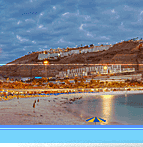
Home to Amadores Beach
Sea Conditions and Swimming Safety at Amadores Beach
What the flags mean, where the bay gets deep, jellyfish season in the Canaries, and the official sting protocol.
In short: Amadores is a sheltered, man-made bay with calm, protected water — but it is not a paddling pool. The coral sand shelves into deeper water a short way out, the municipal flag system decides whether bathing is allowed on any given day, and swimming under a red flag is a serious offence. Jellyfish reach the Canary Islands in every season; below is what to do if you are stung.
The short answer
Two breakwaters protect Amadores, so the water near the sand is calm and there are no big waves. The important caveat is the seabed: the imported sand forms a shelf, and beyond it the bottom falls away abruptly into deeper water. If you are not a confident swimmer, or you are with young children, stay in the shallow band where you can still stand with your head above the water.
The single most useful thing to check before you go in is the flag. Green means the sea is calm and bathing is allowed. Yellow means there is a slight swell and you should take care. Red means bathing is prohibited. The rules on Amadores are set by the municipal beach ordinance of Mogán (Ayuntamiento de Mogán), whose current text was given definitive approval in the Boletín Oficial de la Provincia de Las Palmas no. 136 of 11 November 2022.
What the beach flags mean at Amadores
The lifeguard service flies one of three flags. The wording below is taken from the municipal ordinance, article 42.3.
| Flag |
What the ordinance says |
What it means for you |
| Green |
Calm sea; bathing permitted (art. 42.3 a). |
Swim normally, within your ability. |
| Yellow |
Slight swell ("marejadilla"); bathing permitted with limits. Swimming is forbidden where the bather cannot stand with the head above water (art. 42.3 b). |
Go in only where you can keep your feet down; keep children close to the shore. |
| Red |
Swell ("marejada"); bathing prohibited. Flown when bathing is a serious risk to life or health (art. 42.3 c). |
Stay out of the water. Bathing under a red flag is a serious ("grave") infraction. |
Two things worth knowing. First, the yellow and red flags are also used to keep people out of the water for reasons other than swell — animals, floating objects or pollution (art. 42.3 b and c) — so a red flag is not always about big waves. Second, where there is no lifeguard the beach must carry the sign "Playa no vigilada, en caso de emergencia llamar al 112" ("Beach not guarded — in an emergency call 112"), per article 42.2. If you see no flag and no lifeguard, treat bathing as entirely your own responsibility.
The municipality also advises against bathing between sunset and sunrise, on the basis that anyone who does so takes full responsibility for their own safety (art. 43).
Where the bay gets deep — and why the red flag matters
Amadores is an artificial bay. The breakwaters do their job: sheltered from the open Atlantic, it stays calm in conditions that would make other Gran Canaria beaches unusable. But the sea is not uniformly shallow. The imported coral sand builds up a shelf near the shore, and beyond it the seabed drops away quickly. That rapid change from ankle-deep to over-your-head is the most commonly repeated warning in visitor reviews of this beach, and it is why the municipal rule for a yellow flag is specifically about whether you can still stand up.
Mogán treats swimming while the red flag is flying as a serious infraction carrying a fine of €451 to €900 (art. 45.B.10, read with art. 46). The full municipal fine scale is up to €450 for a minor offence, €451–€900 for a serious one, and €901–€1,800 for a very serious one (art. 46). The fine is beside the point: the red flag is flown when bathing is judged a serious risk to life or health.
Jellyfish in the Canaries: when and what
There is no published jellyfish count for Amadores itself, so treat any claim about "jellyfish season in Amadores" with caution. What is documented is the island-wide pattern. A peer-reviewed study of the Canary Islands — carried out at Las Canteras in Las Palmas, not at Amadores — found that stings cluster in spring and summer; that the mauve stinger Pelagia noctiluca is present all year and most abundant in summer; that Physalia physalis (Portuguese man o' war) and Velella velella appear in winter; and that sea-surface temperature is the strongest predictor of when they arrive. Read that as a guide to the archipelago as a whole, not a forecast for this bay on a given day.
Spain's environment ministry (Miteco) gives two practical rules for the beach. Do not touch jellyfish, dead or alive: the stinging cells stay active for up to 24 hours after the animal is out of the water. And during a bloom, avoid even the shoreline, because the breaking zone concentrates fragments of tentacle. If you are unsure what you are looking at, ask the beach surveillance service.
If you are stung: the official protocol
Miteco's official first-aid sequence for a jellyfish sting, in order:
- Get out of the water. Do not rub or scratch the affected area.
- Rinse with sea water only — never fresh water.
- Remove any remaining tentacle with tweezers, not with your fingers.
- Apply cold — an ice pack wrapped in cloth — for about 15 minutes, without rubbing.
- Do not apply ammonia, vinegar or urine.
- Go to hospital if there is nausea, dizziness, cramps or headache.
Children, older people, asthmatics and anyone with allergies are the higher-risk groups and should be watched more closely after a sting.
Who is watching the beach
The rescue and lifeguard service — surveillance and assistance — on Mogán's beaches is provided by the municipal company Mogán Gestión Municipal, S.L. (CIF B35745843), wholly owned by the Ayuntamiento. The service is real, and it responds: on 6 February 2023 the beach lifeguard service took a 60-year-old bather from the water at Playa de Amadores with signs of incomplete drowning, and the 1-1-2 emergency service dispatched medical and beach-rescue teams.
Two powers of the beach staff are worth knowing. They may order all umbrellas closed during strong wind gusts, for safety (art. 9), and the sunset-to-sunrise advisory (art. 43) means an evening swim is yours alone. The emergency number anywhere in Spain is 112.
Sun, belongings and everything else
This page is about the sea. For sunburn, skin protection and keeping your belongings safe, see the site's main safety guide; for the Blue Flag award itself, see Blue Flag at Amadores Beach. If you would rather be in the water than reading about it, start with the activities and water sports guide, and families will want the family beach guide. For arrival, parking and timings, see how to get to Amadores. Conditions change with the season, so check Amadores weather and when to go before you pack.
Sources
- Ordenanza Municipal de uso y aprovechamiento de las Playas del litoral de Mogán (Ayuntamiento de Mogán; definitive approval, Boletín Oficial de la Provincia de Las Palmas no. 136, 11 November 2022) — articles 9, 42.2, 42.3, 43, 45 and 46.
- Miteco (Ministerio para la Transición Ecológica), "Campaña medusas" — "Recomendaciones a los bañistas" and the medusas FAQ, miteco.gob.es.
- Gobierno de Canarias press releases (1-1-2 Canarias) on the Playa de Amadores rescue of 6 February 2023.
- Peer-reviewed study of jellyfish seasonality and sting records in the Canary Islands (study beach: Las Canteras, Las Palmas), ScienceDirect, article S1385110125000231.
- Mogán Gestión Municipal, S.L. — rescue and lifeguard service contract information, gestmogan.com (portal de transparencia).
|